 Call us now:


Table of Contents
- What Is DOT-Compliant RTD Testing and Why It Matters
- How to Find DOT-Compliant RTD Testing Locations Near You
- Return-to-Duty Test Without an Employer: What You Need to Know
- FMCSA Return-to-Duty Drug Test: Requirements and Process
- Return-to-Duty Test Scheduling: Booking Your Appointment
- FMCSA Clearinghouse Return-to-Duty Test Reporting and Results
- Common Mistakes to Avoid During Your RTD Test
- Next Steps After Passing Your DOT-Compliant RTD Test
- Frequently Asked Questions
Last Updated: October 17, 2026
What Is DOT-Compliant RTD Testing and Why It Matters
DOT-compliant RTD testing is the mandatory final step a commercial driver must complete to clear a prohibited status in the FMCSA Clearinghouse. RTD stands for return-to-duty, and it’s the only path back to safety-sensitive driving after a drug or alcohol violation.
The stakes are clear: without a passing RTD test reported to the FMCSA Clearinghouse, you remain prohibited from operating a commercial vehicle. Your career stays sidelined. That’s why finding the right testing location and understanding the compliance requirements isn’t optional, it’s essential to moving forward.
At RTDStep5, we work with drivers who’ve completed their SAP requirements and are ready for this final step. The confusion most drivers face isn’t about passing the test itself.
This guide walks you through exactly how to locate DOT-compliant RTD testing near you, verify compliance before you arrive, understand your options if you don’t have an employer, and prepare for the appointment so nothing goes wrong.
How to Find DOT-Compliant RTD Testing Locations Near You
Finding a testing location sounds straightforward until you realize not every drug testing facility is DOT-compliant. A standard collection site won’t work for your RTD test. You need a facility that operates under 49 CFR Part 40, the federal regulation governing drug and alcohol testing for commercial drivers.
The fastest way to locate compliant sites is through a Certified Third Party Administrator (C/TPA) network. A C/TPA is an FMCSA-registered organization that maintains a database of approved collection sites and handles the reporting to the FMCSA Clearinghouse. RTDStep5 operates as an FMCSA-registered C/TPA with access to over 24,000 testing sites nationwide. When you use a C/TPA, you’re not searching blindly, you’re tapping into a vetted network.
Without a C/TPA, finding a compliant site requires calling collection facilities directly and asking specific questions: Are you registered with SAMHSA? Do you follow 49 CFR Part 40? Can you report directly to the FMCSA Clearinghouse? Many facilities can’t answer yes to all three.
Using a C/TPA Network to Locate Testing Sites
A C/TPA network eliminates the legwork. When you contact RTDStep5 or another registered C/TPA, you provide your location or preferred area, and the organization matches you with nearby compliant collection sites. The C/TPA typically offers same-day or next-day appointments depending on availability in your region.
The network approach also ensures consistency. Every site in a C/TPA’s network has been vetted for compliance. You’re not gambling on whether the facility knows the rules. They do, because their participation in the network depends on it.
For owner-operators and drivers in rural areas, a C/TPA network is often the only practical option. Rural areas may have only one or two compliant sites within a reasonable driving distance, and a C/TPA knows which ones they are.
Verifying DOT Compliance Before You Arrive
Before you commit to an appointment, verify three things: SAMHSA registration, 49 CFR Part 40 certification, and Clearinghouse reporting capability.
Ask the collection site directly: “Are you SAMHSA-certified?” SAMHSA (Substance Abuse and Mental Health Services Administration) maintains a registry of certified laboratories and collection sites. If a facility isn’t on that registry, it’s not compliant.
Second, confirm they follow 49 CFR Part 40. This federal regulation dictates how specimens are collected, stored, tested, and reported for commercial driver testing.
Third, ask whether they report directly to the FMCSA Clearinghouse or whether you’ll need to submit results yourself. The best option is a site that reports automatically. If you’re responsible for submitting, there’s a risk of delay or error.
When you work through a C/TPA like RTDStep5, this verification is already done. The network maintains compliance. You can move forward knowing the site is legitimate.
Return-to-Duty Test Without an Employer: What You Need to Know
One of the biggest barriers drivers face is the assumption that an employer must order the RTD test. That’s not true. You can arrange and pay for your own RTD test if you’re between jobs, self-employed, or your previous employer won’t handle it.
If you’re unemployed or an owner-operator, you have two paths. First, you can contact a C/TPA directly and request an individual RTD test. RTDStep5 processes tests for drivers without employers. You’ll schedule the appointment, provide your SAP completion documentation, and pay for the test yourself.
Second, you can wait until you secure a new job and have the employer order the test. This approach works if you’re actively job-hunting and expect to land a position soon.
The faster option is to take control of the process yourself. Pay for the test, get it done, and clear your status. Then you can apply for jobs from a position of compliance rather than prohibition.
FMCSA Return-to-Duty Drug Test: Requirements and Process
The FMCSA return-to-duty drug test follows a specific protocol outlined in 49 CFR Part 40. Understanding the requirements ensures you’re prepared and reduces the chance of procedural errors that could invalidate your result.
The test itself is a urine specimen collection for drug screening. The collection process is standardized: you’ll provide a specimen under observation, the specimen will be sealed and labeled with your identifying information, and it will be sent to a SAMHSA-certified laboratory for analysis.
The laboratory screens for five drug classes: marijuana, cocaine, amphetamines, opioids, and phencyclidine (PCP). If the initial screening is negative, your test is complete and reported as negative. If the screening is positive, the specimen goes to a Medical Review Officer (MRO) for review.
An MRO is a licensed physician trained in substance abuse testing. The MRO reviews the positive result, checks for legitimate medical explanations (prescribed medications, for example), and contacts you to discuss the result.
The entire process varies by laboratory workload.
Return-to-Duty Test Scheduling: Booking Your Appointment
Scheduling your RTD test requires a few pieces of information and documentation. Have your CDL number, your SAP completion certificate, and your identification ready before you call.
When you contact a testing facility or C/TPA, you’ll provide your preferred location and available appointment times. Many facilities offer same-day appointments for RTD tests because they’re time-sensitive. RTDStep5 can often schedule appointments depending on your location.
Confirm the appointment details: the date, time, location address, and parking instructions. Ask whether you need to arrive early for paperwork or whether you should arrive exactly at your scheduled time. Arriving late can result in a rescheduled appointment, which delays your clearance.
What to Bring and How to Prepare
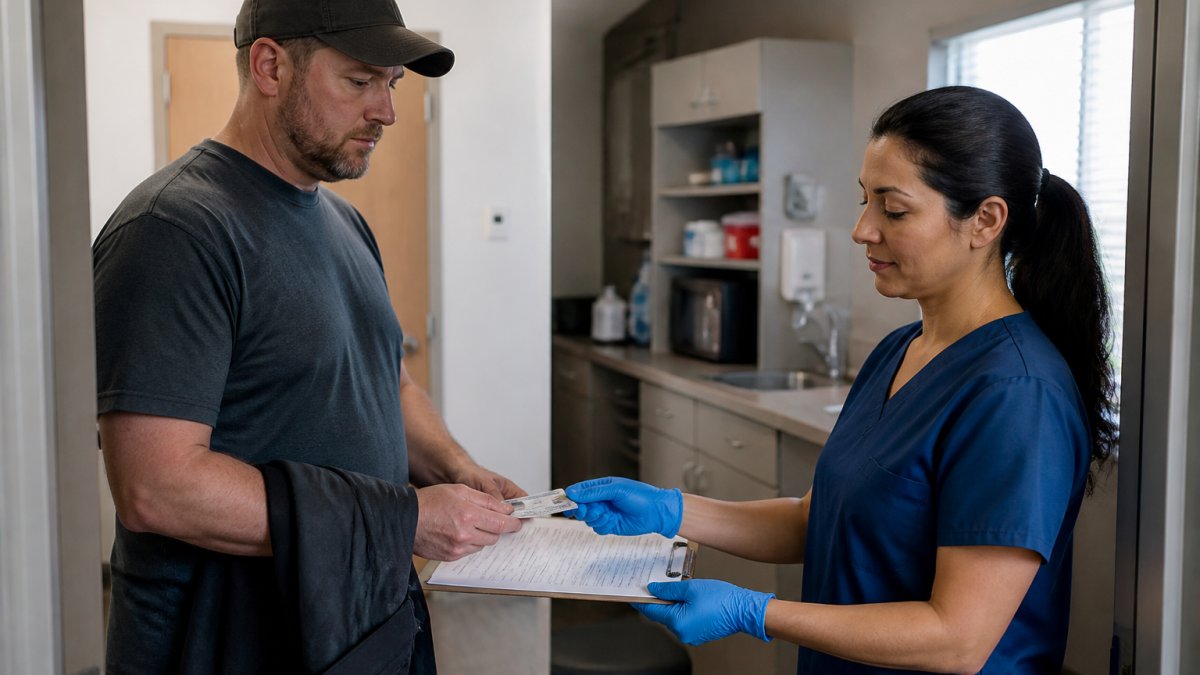
Bring two forms of identification to your appointment. At least one must be government-issued (driver’s license, passport, military ID). The collection site will verify your identity against your CDL information to ensure the test is attributed correctly.
Bring your SAP completion certificate or documentation. The collection site needs proof that you’ve completed your SAP evaluation and any required treatment or education. Without this documentation, the facility may refuse to conduct the test.
Wear comfortable, loose-fitting clothing. The collection process requires you to wash your hands, and you may need to empty your pockets. Avoid wearing a belt or anything that could be perceived as concealing something. Collection sites take security seriously to prevent specimen tampering.
Avoid consuming large amounts of liquid immediately before your appointment. You’ll need to provide a specimen, and arriving over-hydrated can complicate the collection process.
Same-Day and Expedited Appointment Options
If your situation is urgent, ask about same-day appointments. Many collection sites reserve slots for RTD tests because drivers need them quickly. RTDStep5’s network of 24,000+ testing sites across the country makes same-day appointments possible in most areas.
Some C/TPAs also offer expedited reporting. After your specimen is collected, the laboratory prioritizes your test for analysis and the MRO prioritizes the review. Ask whether expedited options are available and what they cost.
FMCSA Clearinghouse Return-to-Duty Test Reporting and Results
After your test is collected and analyzed, the results must be reported to the FMCSA Clearinghouse. This is where many drivers lose track of their status. The test doesn’t clear you, the Clearinghouse report clears you.
If your result is negative, the collection site or C/TPA reports it to the Clearinghouse immediately. Your prohibited status should clear within 24 hours of the report being submitted.
If your result is positive, the MRO contacts you for a review. If the MRO confirms the positive result, it’s reported to the Clearinghouse as a positive RTD test. This does not clear your status.
When you work with RTDStep5 or another C/TPA, the organization handles the Clearinghouse reporting on your behalf. You don’t have to submit anything yourself.
Check your Clearinghouse status within 24-48 hours of your test. If your result was negative and your status hasn’t updated, contact the C/TPA or collection site immediately.
Common Mistakes to Avoid During Your RTD Test
The most common mistake is arriving unprepared. Drivers show up without their SAP completion certificate or with only one form of identification. The collection site won’t proceed without proper documentation, and you’ll need to reschedule.
A second mistake is misunderstanding what an RTD test covers. Some drivers arrive expecting only an alcohol test or only a drug test. The federal requirement is both. You’ll be tested for drugs and alcohol.
Third, drivers sometimes use a non-compliant testing facility to save money or time. A cheaper or faster collection site that isn’t DOT-compliant will invalidate your test.
Another mistake is failing to follow the collection protocol during the test. This includes attempting to dilute your specimen, refusing to provide a sample, or not following the collector’s instructions.
Finally, drivers sometimes assume the test is complete after collection. It’s not. The specimen must be analyzed, the MRO must review it, and the result must be reported to the Clearinghouse.
Next Steps After Passing Your DOT-Compliant RTD Test
Once your negative RTD result is reported to the FMCSA Clearinghouse, your prohibited status clears. You’re eligible to return to safety-sensitive driving immediately. However, “eligible” and “employed” are different things.
Verify your Clearinghouse status is clear before applying for jobs. Potential employers will check your status, and you want to confirm it’s been updated correctly.
If you’re returning to your previous employer, notify them that your RTD test is complete and your status is cleared. Some employers have a rehiring process or probationary period.
If you’re applying to new employers, your clear Clearinghouse status is your credential. Include it in your application materials.
For owner-operators, a cleared status means you can resume operations immediately.
Finding and scheduling DOT-compliant RTD testing shouldn’t add stress to an already challenging situation. The process is straightforward when you know where to look and what to verify.
Frequently Asked Questions
Where can I find DOT-compliant RTD testing locations near me?
DOT-compliant RTD testing is available through registered Certified Third Parties (C/TPAs) that operate nationwide networks of collection sites. A C/TPA like RTDStep5 maintains access to over 24,000 testing locations and can direct you to the nearest compliant site based on your location. You can also search the FMCSA’s list of registered C/TPAs, though using an established network ensures faster scheduling and guaranteed compliance with 49 CFR Part 40 requirements.
Can I take a return-to-duty test without an employer?
Yes. If you’re an owner-operator, self-employed, or currently unemployed, you can arrange your own return-to-duty test without employer involvement. You’ll order the test directly through a C/TPA, pay for it yourself, and provide the required documentation (SAP completion letter, valid ID, and medical history form). The C/TPA handles collection, laboratory analysis, Medical Review Officer (MRO) review, and Clearinghouse reporting on your behalf.
How long does it take for my RTD test result to appear in the FMCSA Clearinghouse?
After you pass your FMCSA return-to-duty drug test, the C/TPA submits results to the MRO for review. Once the MRO approves the result, the C/TPA files the report with the FMCSA Clearinghouse. Most drivers see their prohibited status cleared within a few business days of test completion, though expedited reporting options may shorten this timeline. Verify clearance directly in your FMCSA Clearinghouse account before resuming safety-sensitive duties.
What documents do I need to bring to my DOT-compliant RTD test?
Bring a valid government-issued photo ID, your SAP completion letter, and a medical history form (provided by your C/TPA or the collection site). Some sites may also request your commercial driver’s license. Arrive 10-15 minutes early to complete chain-of-custody paperwork. Having these documents ready prevents delays and ensures the test meets 49 CFR Part 40 compliance standards required for Clearinghouse reporting.