 Call us now:

Table of Contents
- What Is the Return to Duty Testing Procedure?
- The Role of the Substance Abuse Professional in Your RTD Process
- How Long Does the SAP Process Take?
- DOT Follow-Up Testing Requirements and Your Step 5 Test
- How to Get Back to Driving After a Drug Violation
- Return to Duty Test Cost and What to Expect
- Avoiding Common Mistakes in Your Return to Duty Testing Procedure
- Frequently Asked Questions
Last Updated: September 27, 2026
What Is the Return to Duty Testing Procedure?
The return to duty testing procedure is the final, mandatory step that allows a commercial driver with a drug or alcohol violation to clear their prohibited status in the FMCSA Clearinghouse and resume safety-sensitive driving. This process, known as Step 5 of the Substance Abuse Professional (SAP) protocol, requires you to pass a urine drug screen or alcohol test after completing your treatment and education requirements.
Here’s what makes this critical: without successfully completing the return to duty testing procedure, your prohibited status remains active in the federal clearinghouse. You cannot legally operate a commercial vehicle. The test itself is straightforward, a supervised specimen collection at a DOT-compliant facility, but the compliance and reporting requirements are strict. One procedural error, and your clearance gets delayed or denied.
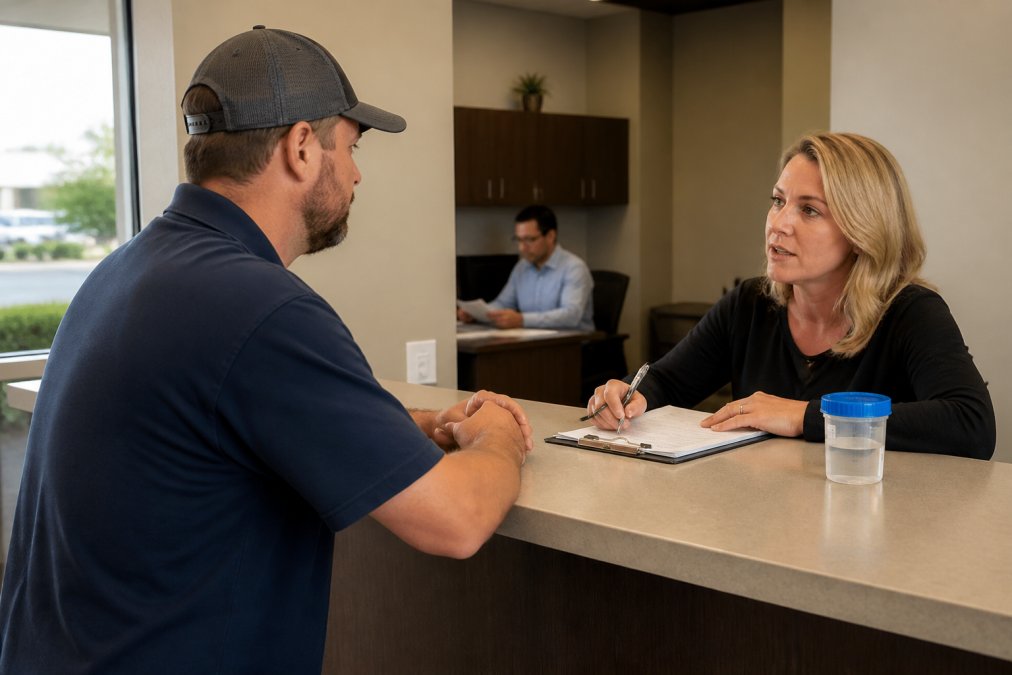
The return to duty testing procedure involves three essential elements: the actual drug or alcohol test, proper specimen collection under direct observation, and immediate reporting to the FMCSA Clearinghouse. Unlike routine workplace drug screens, this test must be ordered by an employer or authorized representative, collected at a certified facility, and reported within specific timeframes. Your test result, whether negative or non-negative, goes directly into the federal system. A negative result clears your prohibited status. A non-negative result means you’ll need additional treatment and another attempt.
RTDStep5 simplifies this final step by connecting you with a nationwide network of over 24,000 testing sites and handling the Clearinghouse reporting directly. This eliminates the confusion many drivers face when trying to coordinate the test on their own.
The Role of the Substance Abuse Professional in Your RTD Process
The Substance Abuse Professional plays a gatekeeping role in your return to duty testing procedure. Your SAP is the licensed clinician who evaluates your progress, determines whether you’ve completed sufficient treatment, and signs off on your readiness for the final test. Without SAP clearance, you cannot proceed to Step 5.
Your initial SAP evaluation happened early in your process. That assessment determined what level of treatment you needed, outpatient education, intensive outpatient, or residential treatment. As you complete those requirements, your SAP tracks your progress. Some drivers complete their obligations in weeks; others need months. The SAP’s job is to ensure you’ve genuinely addressed the underlying issue, not just checked boxes.
When your treatment is complete, the SAP conducts a follow-up evaluation. This is where they verify you’ve attended all required sessions, participated meaningfully, and demonstrated behavioral change. Only after this follow-up evaluation does the SAP clear you for your return to duty testing procedure. This clearance is non-negotiable, federal regulations require it. You cannot skip this step or move forward without it.
The SAP also provides a written report documenting your completion of the education or treatment program. This report becomes part of your federal record. When you schedule your Step 5 test, you’ll need proof that your SAP has cleared you.
How Long Does the SAP Process Take?
The timeline for the SAP process varies considerably depending on the level of treatment required and your individual circumstances. Most drivers spend between 6 and 12 weeks in the SAP program from initial evaluation through follow-up evaluation, but some complete it faster while others need more time.
Your initial evaluation typically happens within days of your violation being reported to the Clearinghouse. That’s the quick part. The real timeline depends on your assigned treatment level. If you’re ordered to attend an education program only, you might complete it in 4 to 6 weeks. Intensive outpatient programs usually run 6 to 12 weeks. Residential treatment can extend 4 to 12 weeks or longer depending on the program and your progress.
Once you finish your treatment requirements, schedule your follow-up SAP evaluation. This appointment typically happens within 1 to 2 weeks after you complete your last treatment session. The SAP reviews your records, confirms your attendance and participation, and conducts a clinical assessment. If everything checks out, they clear you for your return to duty testing procedure on the same day or within days.
From that point, you’re ready to schedule your Step 5 test. Many drivers can schedule within 1 to 2 weeks. The actual test takes 15 to 30 minutes at the collection facility. Results are typically reported to the Clearinghouse within 24 to 48 hours.
The total timeline from violation to clearance usually ranges from 3 to 6 months.
DOT Follow-Up Testing Requirements and Your Step 5 Test
Your return to duty testing procedure is technically your Step 5 test, but federal regulations don’t stop there. DOT follow-up testing requirements begin immediately after you clear your prohibited status and continue for a specific period.
Here’s the distinction: the return to duty test is the one-time, mandatory test you take after SAP clearance. Once you pass it, your prohibited status is removed from the Clearinghouse. However, federal law requires your employer to enroll you in a follow-up testing program for the next 12 months. This follow-up testing is unannounced, random, and more frequent than standard workplace drug testing.
The follow-up testing requirements mandate that you be tested at least 6 times during the 12-month period following your return to duty test. These tests are random and unannounced, your employer selects you through a randomization process. You could be selected once in that year, or you could be selected multiple times. The tests are conducted the same way as your Step 5 test: urine drug screen or breath alcohol test at a certified facility.
This follow-up testing serves a regulatory purpose. It demonstrates to the federal government that you’re maintaining sobriety and fitness for duty.
Pro Tip
Keep your SAP’s clearance letter and your Step 5 test results in a safe place. You’ll need them for your employer’s records and for your own documentation. The Clearinghouse will show when your prohibited status was cleared, but having physical copies protects you if questions arise.
Keep your SAP’s clearance letter and your Step 5 test results in a safe place. You’ll need them for your employer’s records and for your own documentation. The Clearinghouse will show when your prohibited status was cleared, but having physical copies protects you if questions arise.
How to Get Back to Driving After a Drug Violation
Getting back to driving after a drug violation requires following a specific sequence of steps. Skipping or rushing any of them will delay your return.
Return to Duty Test Cost and What to Expect
The cost of your return to duty testing procedure varies depending on your treatment level and testing location.
Watch Out
Do not attempt to schedule your return to duty test without your SAP’s written clearance. Facilities will turn you away, and you’ll waste time and money. Verify you have your clearance letter before contacting RTDStep5 or any testing facility.
Do not attempt to schedule your return to duty test without your SAP’s written clearance. Facilities will turn you away, and you’ll waste time and money. Verify you have your clearance letter before contacting RTDStep5 or any testing facility.
Avoiding Common Mistakes in Your Return to Duty Testing Procedure
Most mistakes in the return to duty testing procedure stem from rushing, misunderstanding requirements, or poor coordination between parties.
Frequently Asked Questions
What is the return-to-duty testing procedure for CDL drivers?
The return to duty testing procedure is the final step (Step 5) that CDL drivers must complete after a drug or alcohol violation. It involves a urine drug screen or alcohol test following completion of SAP evaluation, treatment, and education requirements. The test must be conducted by a DOT-compliant testing facility and reported to the FMCSA Clearinghouse. Once you pass, your prohibited status is cleared and you can resume safety-sensitive driving duties.
How long does the SAP process take before I can do my return to duty test?
The SAP process typically takes 4-8 weeks, depending on the complexity of your case and treatment requirements. The initial evaluation may take 1-2 weeks, followed by education and treatment programs that vary in duration. Your SAP will establish a specific timeline and must clear you before you’re eligible to schedule your Step 5 return to duty test. Delays can occur if treatment recommendations extend beyond the standard timeframe.
What happens if I fail my return to duty test?
If you fail your return to duty test, you remain in prohibited status and cannot perform safety-sensitive functions. You must return to your SAP for re-evaluation and additional treatment recommendations. After completing the new treatment plan, you’ll need to schedule another return to duty test. Multiple failures may result in stricter requirements or longer rehabilitation periods before you’re eligible to test again.
Who schedules my return to duty test, my employer or me?
Typically, your employer or a Certified Third-Party Administrator (C/TPA) schedules the return to duty test on your behalf. However, if you’re unemployed or between jobs, you can work directly with a C/TPA like RTDStep5 to arrange testing without employer involvement. The important requirement is that the test is conducted at a DOT-compliant facility and properly reported to the FMCSA Clearinghouse to clear your prohibited status.
How do I know my return to duty test was reported correctly to the FMCSA Clearinghouse?
Your testing facility or C/TPA should provide you with documentation confirming the test was completed and reported. You can verify clearance by checking your FMCSA Clearinghouse record directly using your CDL number. Your prohibited status should update within 1-2 business days after a passing test is reported. If it doesn’t update, contact your C/TPA or the testing facility immediately to investigate and correct any reporting errors.
What are DOT follow-up testing requirements after I clear my prohibited status?
After you pass your return to duty test and clear your prohibited status, you may be subject to DOT follow-up testing for up to 60 months (5 years). Your SAP will specify the frequency and type of follow-up tests required in your case. These unannounced tests help ensure ongoing compliance and are part of your rehabilitation monitoring. Your employer or C/TPA will manage scheduling these follow-up tests according to your SAP’s recommendations.
What is the cost of a return to duty test?
Return to duty test costs vary depending on your location, the type of test (urine drug screen or alcohol test), and whether you use a C/TPA service. Pricing depends on several factors including facility location, testing complexity, and reporting requirements. For current, accurate pricing and transparent cost information, visit RTDStep5’s pricing page or contact them directly for a quote tailored to your situation.