 Call us now:


Last Updated: November 24, 2026
Quick Summary
A return-to-duty test result is processed in stages: specimen collection, laboratory analysis, Medical Review Officer (MRO) review, employer notification, and FMCSA Clearinghouse reporting. Negative results move fastest, while non-negative results add confirmation and donor contact that lengthen the timeline.
- Laboratory turnaround is only one segment of the full timeline.
- Non-negative results require confirmation and MRO contact with the donor.
- Invalid results may require a recollection, which restarts the clock.
- Weekends and federal holidays can extend processing.
- Clearinghouse updates are not instant, so allow extra business days.
Ready to book your Step 5 test?RTDStep5 supports DOT-compliant Step 5 testing and Clearinghouse reporting nationwide.
Table of Contents
- How Long Does Return-to-Duty Test Result Processing Take?
- The Return-to-Duty Process From Start to Finish
- Laboratory Turnaround vs. the Full RTD Timeline
- Result Timelines by Outcome and Test Type
- What Causes Delays and What to Do If Your Result Is Late
- How Clearinghouse Reporting Fits Into the Timeline
- Scheduling Your DOT Return-to-Duty Drug Test
- Booking Your Step 5 Test and Getting Back on the Road
- Frequently Asked Questions
How Long Does Return-to-Duty Test Result Processing Take?
Return-to-duty test results take time to process, and the exact time depends on the laboratory, the Medical Review Officer (MRO), and whether the result is negative or non-negative. A driver’s RTD test result is not the same as their return to safety-sensitive work, which requires additional steps. Understanding each stage helps you plan and avoid unnecessary delays.
This guide explains each step so you know what to expect and when.
The process generally has three stages: specimen collection, laboratory analysis, and MRO review. Most of the waiting happens during the lab and review stages. Each stage can take longer if the paperwork has errors or the result requires verification.
FMCSA Drug and Alcohol Testing regulations, 49 CFR Part 40
The Return-to-Duty Process From Start to Finish
The return-to-duty process has several required steps. Each step must be completed in order before a driver can resume safety-sensitive functions.
- Complete the Substance Abuse Professional (SAP) evaluation
- Finish all required education or treatment
- Receive a SAP follow-up compliance decision
- Complete the return-to-duty drug or alcohol test
- Report the result to the FMCSA Clearinghouse
Not every driver needs every step in the same way. Your SAP will set the exact requirements in your case. Ask your SAP to confirm what remains before you schedule your test.
Laboratory Turnaround vs. the Full RTD Timeline
Laboratory turnaround is only one segment of the full timeline. The lab reports a result to the MRO, but that does not mean the driver is cleared to drive. The keyword asks about result processing time, so it helps to separate the stages that actually consume time instead of treating “the result” as a single event.
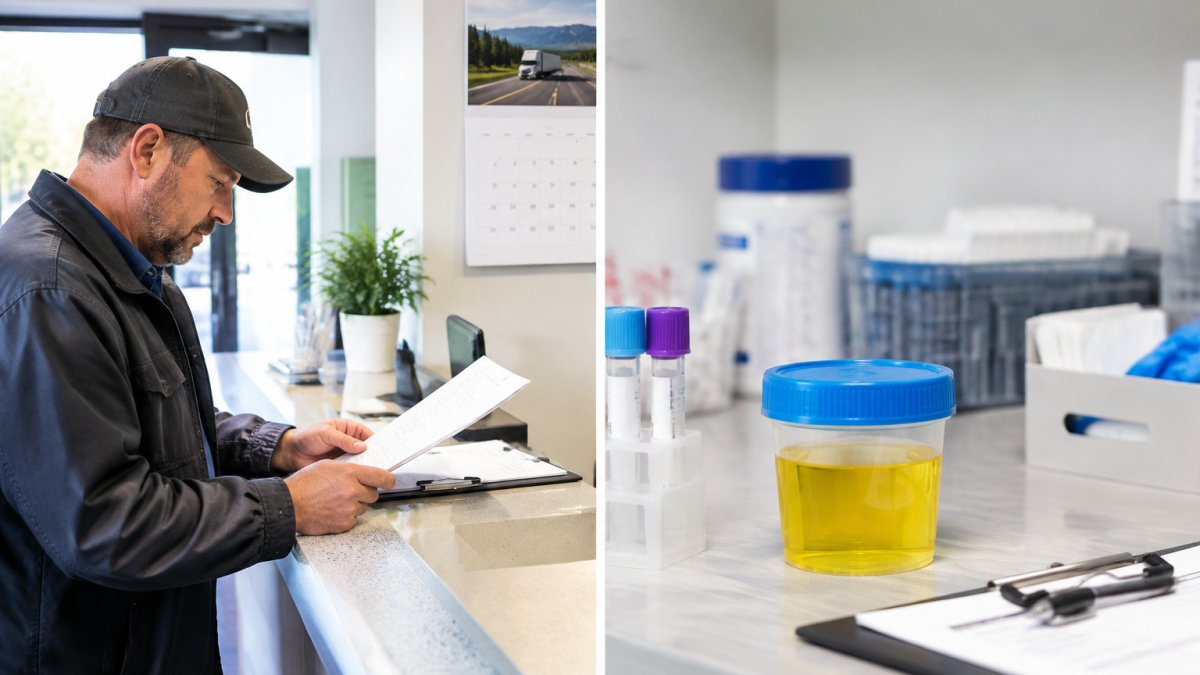
A practical way to think about it is a chain of five milestones, each with its own clock:
- Specimen collection. The collector completes the custody-and-control form (CCF) and ships the specimen. Collection itself is quick, but shipping and accessioning at the laboratory can add time, especially if the specimen is collected late in the day or before a weekend.
- Laboratory analysis. The lab runs the initial immunoassay screen and, if needed, a confirmatory test. A negative screen usually moves fastest; a specimen that requires confirmation adds a second analytical step.
- MRO review. A qualified Medical Review Officer reviews the result. For a non-negative result, the MRO must contact the donor to discuss legitimate medical explanations. For a non-negative result, the MRO must contact the donor to discuss legitimate medical explanations, and that contact attempt is one of the most common sources of delay.
- Employer notification. The MRO reports the verified result to the employer (or the C/TPA acting for the employer). This is a separate handoff from the lab-to-MRO step and can lag if contact information is wrong or the employer’s designated contact is unavailable.
- Clearinghouse reporting. For DOT-covered drivers, the employer or C/TPA reports the RTD result to the FMCSA Clearinghouse. Reporting is typically not instant, and the record update can take additional business days to appear.
Laboratory turnaround is the time between specimen collection and the lab’s reported result. Weekends and holidays can extend laboratory turnaround. The full RTD timeline includes MRO review, reporting to the employer, Clearinghouse updates, and the employer’s decision. Each of these can add time, and they do not all run on the same clock.
A common mistake is assuming the lab result date is the date you can return to work. The lab result is an analytical finding; the MRO verification is a medical determination; the employer’s decision and the Clearinghouse status are separate milestones. Plan for the full chain, not just the lab step.
Watch out: A result that appears “done” in one system (for example, the lab portal) may still be pending MRO review or employer notification, so confirm each milestone rather than assuming the first status you see is the final one.
FMCSA Drug and Alcohol Testing regulations, 49 CFR Part 40
Result Timelines by Outcome and Test Type
Timelines can vary based on whether the result is negative or non-negative, and on the type of test. The reason is mechanical: each outcome triggers a different number of review and contact steps, and each specimen type has its own analytical path.
By outcome:
- Negative result. The lab reports a negative screen, the MRO confirms the CCF matches and the specimen is valid, and the result is verified. This is the shortest path because it usually requires no donor contact. The lab step itself still depends on shipping and workload.
- Non-negative result. A non-negative (for example, a positive screen or a refusal-related finding) requires confirmatory testing and then MRO contact with the donor to discuss legitimate medical explanations. Each contact attempt can add time, and if the donor cannot be reached, the MRO may need additional attempts before verifying. This is the single largest source of outcome-driven delay.
- Invalid result. An invalid specimen (for example, a specimen that is dilute or otherwise not suitable for testing) may require the MRO to direct a recollection. That recollection restarts the collection-and-analysis clock, so an invalid result can effectively double the timeline.
- Cancelled test. A cancelled test (for example, a CCF error or a specimen that cannot be tested) does not produce a result at all. The correction and recollection process adds time, and the employer or C/TPA must ensure the paperwork is fixed before a new specimen is collected.
By test type:
- Urine tests. The standard DOT specimen type, with a well-established laboratory workflow. Turnaround is generally predictable, but confirmation testing and MRO contact still apply to non-negative results.
- Oral-fluid tests. Where permitted under the applicable DOT agency rules, oral-fluid collection can simplify observed-collection logistics, but the analytical and MRO review steps still apply, so do not assume a faster verified result just because collection was easier.
- Other specimen types. Any specimen type beyond the standard DOT panel may have different processing steps, so confirm with your testing provider rather than assuming the urine timeline carries over.
Exact timelines vary by laboratory and testing program. Ask your C/TPA for the current estimate for your specific test, and ask specifically whether the estimate covers lab turnaround only or the full path through MRO verification and employer notification.
Watch out: A “non-negative” label is not the same as a verified positive, and an “invalid” or “cancelled” result is not a pass or a fail, each has its own follow-up step, so confirm the actual status before you change your plans.
The table below summarises how each outcome and test type affects how long processing takes, as described above.
| Outcome or test type | Timeline effect | Note |
|---|---|---|
| Negative result | Shortest path | Usually no donor contact needed |
| Non-negative result | Largest outcome-driven delay | Requires confirmation and MRO contact with donor |
| Invalid result | Can roughly double the timeline | May require a recollection |
| Cancelled test | No result produced | Paperwork must be corrected before recollection |
| Urine tests | Predictable turnaround | Standard DOT specimen type |
| Oral-fluid tests | Easier collection | Analysis and MRO review still apply |
What Causes Delays and What to Do If Your Result Is Late
Several common factors can slow down processing:
- Weekends and federal holidays
- Incomplete or incorrect paperwork
- Non-negative results that need verification
- Delays in reporting from the testing site
- Gaps in communication between the employer and the C/TPA
If your result is late: Contact your C/TPA first and ask for the status of your specimen. For practical steps to shorten the wait, see avoiding delays in FMCSA reinstatement. Ask whether the MRO has received the result. Keep a written record of every call, including the date, time, and the name of the person you spoke with.
Watch out: Do not assume a missing result means a failed test. Ask for the actual status before you worry or change your plans.
How Clearinghouse Reporting Fits Into the Timeline
The FMCSA Clearinghouse is the national database that tracks driver drug and alcohol violations. Reporting to the Clearinghouse is a required step in the return-to-duty process.
Your employer or C/TPA reports your return-to-duty result to the Clearinghouse. Learn how the Clearinghouse reporting process works from start to finish. Once the report is in, your status can be updated. Reporting is typically not instant, so allow extra time for the update to appear.
Review your Clearinghouse record after the report is submitted. Confirm that the result and status match what your SAP and employer expect.
Scheduling Your DOT Return-to-Duty Drug Test
Schedule your test only after your SAP confirms you have completed the required evaluation, education, and treatment steps. Test too early and the result may not count toward your return-to-duty process.
Here is a simple checklist to follow: see the seven concrete scheduling steps laid out in order.
- Get written confirmation from your SAP that you are ready for the RTD test
- Choose a DOT-compliant collection site
- Confirm your employer or C/TPA has the correct paperwork
- Ask how long your result will take to process
- Save a copy of your appointment confirmation
RTDStep5 offers a nationwide network of over 24,000 testing sites and FMCSA-registered C/TPA support.
Booking Your Step 5 Test and Getting Back on the Road
Once your SAP confirms you are ready, book your Step 5 test as soon as possible. Early scheduling reduces the chance of delays later.
Keep your documents organized, track your result, and confirm Clearinghouse reporting before you plan your return to safety-sensitive work.
Get Started on Step 5 Now with RTDStep5. Our nationwide testing network and FMCSA-registered C/TPA support can help you move forward. Visit RTDStep5 for current pricing and to schedule your test.
Frequently Asked Questions
How long does a return-to-duty process take?
The full return-to-duty process usually spans several weeks to months, because it includes the SAP evaluation, any required education or treatment, the observed return-to-duty test, and follow-up testing that can run for up to 12 months. The test result itself is a much smaller piece. After the Medical Review Officer (MRO) verifies the result, the employer and the Clearinghouse can be updated. Timing depends on your SAP’s recommendations and your treatment progress, so confirm your personal schedule with your SAP and employer.
How long does it take to hear back if you fail a drug test?
A non-negative result is first reviewed by the Medical Review Officer, who contacts you to discuss legitimate medical explanations such as a valid prescription. If the MRO verifies the result as positive, the MRO reports it to your employer and the Clearinghouse. Weekends and federal holidays can extend the timeline. If you have not heard anything after the expected window, contact your employer’s designated C/TPA or your MRO directly to ask about the status of your file.
Do drug test results come back faster if they are positive?
No. Laboratory processing follows the same general steps whether a result is negative or non-negative, so a positive or non-negative result does not typically return faster. What can differ is the time after lab reporting: a negative result is usually verified and released quickly, while a non-negative result requires MRO review, which can add time. Results are not expedited by outcome, so plan for similar lab turnaround either way.
Can a driver return to work while waiting for return-to-duty test results?
A driver generally may not perform safety-sensitive functions until the return-to-duty process is complete and the employer has received a verified negative result and the required Clearinghouse query is completed. Waiting for a result means you remain prohibited from safety-sensitive driving. Confirm with your employer and your C/TPA before assuming you can resume work, because the employer must make the return-to-duty determination under DOT rules before you drive.
