 Call us now:

Table of Contents
- What a DOT Drug Test for CDL Drivers Checks
- When the FMCSA Requires a DOT Drug Test
- How the Return-to-Duty Process for CDL Drivers Works
- The Substance Abuse Professional (SAP) Evaluation Explained
- Step-by-Step: What Happens During the Urine Test
- Prescription Meds, CBD, and Avoiding a False Positive
- Your Roadmap Back After a Failed Test
- Conclusion: Get Your CDL Career Back on Track
- Frequently Asked Questions
Last Updated: September 6, 2026
What a DOT Drug Test for CDL Drivers Checks
A DOT drug test for CDL drivers is a federally mandated urine screening that checks for five specific classes of prohibited substances. The test is governed by the Federal Motor Carrier Safety Administration (FMCSA) and applies to anyone operating a Commercial Motor Vehicle (CMV) in a safety-sensitive role.
The five substances screened in a standard 5-panel urine test are:
- THC metabolites (marijuana)
- Cocaine
- Amphetamines, including methamphetamine and MDMA
- Opiates, including heroin, codeine, and morphine
- Phencyclidine (PCP)
A DOT drug test is not a general wellness screening. It targets only these substances because they impair judgment, reaction time, and physical coordination, all critical to safely operating a CMV.
The rules for what constitutes a violation come from the FMCSA, which maintains the official FMCSA drug and alcohol testing regulations. Understanding these five panels matters because a positive result for any one of them triggers the same consequence: a “prohibited” status in the Drug and Alcohol Clearinghouse and removal from safety-sensitive duties.
Watch Out
A positive DOT drug test does not just cost you your current job. It places a “prohibited” status in your FMCSA Clearinghouse record, which blocks you from working for any DOT-regulated employer until you complete [the return-to-duty process](/how-it-works/).
A positive DOT drug test does not just cost you your current job. It places a “prohibited” status in your FMCSA Clearinghouse record, which blocks you from working for any DOT-regulated employer until you complete [the return-to-duty process](/how-it-works/).
When the FMCSA Requires a DOT Drug Test
The FMCSA requires DOT drug testing at specific, non-negotiable points in a commercial driver’s career. If you hold a CDL and operate a CMV, these testing events apply to you.
The required testing occasions are:
- Pre-employment: Before a driver can perform safety-sensitive functions for a new employer, a negative test result must be on file.
- Random testing: Drivers in the random pool are selected on an unannounced basis throughout the year. Selection is computerized and must be truly random.
- Post-accident: Following a qualifying accident, drivers must be tested. The requirement depends on the severity of the incident and whether a citation was issued.
- Reasonable suspicion: If a trained supervisor observes specific, contemporaneous signs of drug use, the driver must submit to a test.
- Return-to-duty (RTD): After a violation, a driver must pass an RTD test before resuming safety-sensitive work.
- Follow-up: After returning to duty, a driver is subject to a minimum of six unannounced follow-up tests in the first 12 months, as directed by a Substance Abuse Professional (SAP).
Each of these testing events serves a distinct compliance purpose, but they all share the same collection and laboratory procedures. The random testing requirement is what makes the DOT program unique; FMCSA guidance on random testing rates confirms that employers must select a specific percentage of their driver pool annually.
What most drivers do not realize is that the return-to-duty test is where they have the most control over speed and accuracy. Unlike random tests ordered by an employer, an RTD test can be initiated by the driver through a qualified third-party administrator.
How the Return-to-Duty Process for CDL Drivers Works
The return-to-duty process is the only official path back to safety-sensitive driving after a drug or alcohol violation. It is a structured sequence of FMCSA-defined steps; skipping any one leaves your Clearinghouse status stuck on “prohibited.”
The process follows this order:
- Violation occurs and is reported to the Drug and Alcohol Clearinghouse by the employer.
- The driver is removed from safety-sensitive functions immediately.
- The driver contacts a Substance Abuse Professional (SAP) for an initial assessment. The SAP is not a medical doctor; they are a certified addiction counselor or similar professional.
- The SAP prescribes a treatment plan, which typically includes education classes, counseling, or in more serious cases, inpatient treatment.
- The driver completes the prescribed program, and the SAP issues a “follow-up testing plan” and a formal release.
- The driver must pass a return-to-duty test with a negative result. This is the Step 5 test.
- The negative result is reported to the Clearinghouse, and the driver’s status changes from “prohibited” to “active.”
- The driver returns to work and is subject to the SAP’s follow-up testing plan.
The step that causes the most delay is Step 6, the actual RTD test. Many drivers finish their SAP program and then wait weeks because they lack an employer to order the test, or their old employer drags their feet. The test itself is straightforward, but the administrative chain, ordering, collection, lab processing, and Clearinghouse reporting, is where things stall.
Key Takeaway
The RTD test is not something you can schedule at any clinic. It must be ordered by a DOT-qualified entity, collected at an approved site, and reported to the Clearinghouse by a registered C/TPA. If any link in that chain is missing, your [prohibited status](/how-to-clear-fmcsa-prohibited-status/) stays.
The RTD test is not something you can schedule at any clinic. It must be ordered by a DOT-qualified entity, collected at an approved site, and reported to the Clearinghouse by a registered C/TPA. If any link in that chain is missing, your [prohibited status](/how-to-clear-fmcsa-prohibited-status/) stays.
The Substance Abuse Professional (SAP) Evaluation Explained
A Substance Abuse Professional (SAP) is the gatekeeper of your return-to-duty process. The SAP is a licensed professional who evaluates whether a driver has a substance abuse problem and prescribes the education or treatment needed to safely return to work. The FMCSA defines the SAP’s role in the FMCSA SAP program requirements, and their evaluation is mandatory after any violation.
The SAP evaluation is a two-part process:
Part 1: The Initial Assessment. You meet with the SAP for a clinical interview. They review the details of your violation, your history, and your current situation. This is not a pass-fail exam; it is a diagnostic session. The SAP determines whether you have a substance abuse disorder and, if so, its severity.
Part 2: The Prescribed Program. Based on the assessment, the SAP issues a formal education or treatment plan. For a first-time, low-severity violation, this might be a 6 to 12 hour education program. For more serious cases, it could involve outpatient counseling or residential treatment.
The driver pays for the SAP evaluation and prescribed program; there is no federal funding. Once you complete the program, the SAP issues a report that includes a follow-up testing plan, typically a minimum of six tests in the first year.
A common mistake is assuming the SAP’s release means you can drive immediately. It does not. The SAP’s report is a prerequisite, not a green light. You must still pass the return-to-duty urine test and have the result reported to the Clearinghouse before you can legally operate a CMV.
Step-by-Step: What Happens During the Urine Test
The return-to-duty urine test follows a strict protocol designed to prevent tampering and ensure the sample is valid. Here is exactly what happens, step by step, at the collection site.
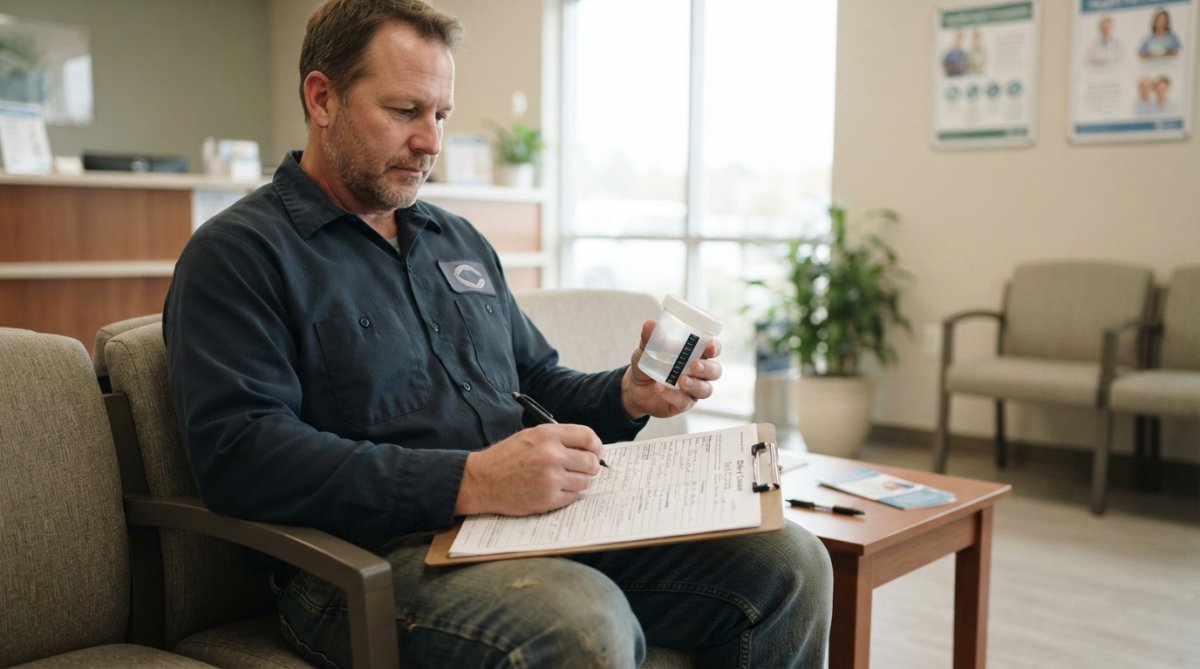
Step 1: Check-in and ID verification. You present a valid government-issued photo ID. The collector verifies your identity and confirms the test order matches your information.
Step 2: Chain of custody form. You and the collector complete a Federal Drug Testing Custody and Control Form (CCF). This document tracks the sample from collection to lab analysis. Any error on this form can invalidate the test.
Step 3: Specimen collection. You provide a urine sample in a private restroom. The collector checks the sample’s temperature and volume immediately. The sample must be within a specific temperature range, typically 90-100 degrees Fahrenheit, to confirm it is fresh.
Step 4: Splitting the sample. The collector splits your urine into two bottles, labeled A and B. Bottle A is the primary sample sent for testing. Bottle B is stored in case you request a split test of the result later.
Step 5: Sealing and shipping. You initial the seals on both bottles. The collector packages them for shipment to a certified laboratory.
Step 6: Laboratory analysis. The lab tests Bottle A for the five prohibited substances. The lab also performs specimen validity testing to check for adulteration or dilution.
Step 7: MRO review. If the lab reports a positive result, a Medical Review Officer (MRO), a licensed physician, reviews the case. The MRO contacts you to discuss any legitimate medical explanation, such as a valid prescription, before the result is finalized.
The entire collection process takes about 15 to 20 minutes. The laboratory analysis typically takes 24 to 72 hours.
Pro Tip
Drink water before your test, but do not overhydrate. A sample that is too diluted is flagged by specimen validity testing and may be treated as a refusal to test. Aim for normal hydration in the hours before your appointment.
Drink water before your test, but do not overhydrate. A sample that is too diluted is flagged by specimen validity testing and may be treated as a refusal to test. Aim for normal hydration in the hours before your appointment.
Prescription Meds, CBD, and Avoiding a False Positive
The most common fear drivers have about the DOT drug test is failing it because of something they took legally. A prescription medication will not cause a false positive for an illicit drug, but there are specific scenarios where a driver can test positive while believing they did nothing wrong.
The critical distinction is between a medical explanation and a prohibited substance. The MRO’s job is to determine whether a positive result has a legitimate medical explanation. If you have a valid prescription for a substance that is also a prohibited drug, the MRO may verify it. However, the FMCSA does not grant a “medical exemption” for prohibited substances based on state law.
For prescription medications, the key issues are:
- Opiates: If you take a prescription opiate like codeine or morphine, it will show up on the 5-panel test. The MRO will verify your prescription, but the FMCSA still considers you unsafe to drive if the medication causes impairment. Many employers will not allow you to drive while taking these medications.
- Amphetamines: Prescription ADHD medications like Adderall are amphetamines. They will show up on the test. A valid prescription does not override the DOT’s prohibition on operating a CMV while impaired.
- CBD products: This is the murkiest area. Hemp-derived CBD products are federally legal, but many contain trace amounts of THC. Over time, or with high doses, these trace amounts can accumulate in your system and trigger a positive result for THC metabolites. The FDA warning on CBD products notes that many CBD products are mislabeled and may contain more THC than stated.
The safest approach for any CDL driver is to assume that any product derived from the cannabis plant, including CBD, carries some risk of a positive THC test. If you use a prescription medication that is also a prohibited substance, disclose it to the MRO immediately if your test comes back positive. Do not attempt to hide it; the MRO process exists to hear your explanation.
Watch Out
“Do not use CBD products if your career depends on a clean DOT drug test. Even “THC-free” labels are not a guarantee. The only way to be certain is to avoid the products entirely while you are subject to DOT testing.
“Do not use CBD products if your career depends on a clean DOT drug test. Even “THC-free” labels are not a guarantee. The only way to be certain is to avoid the products entirely while you are subject to DOT testing.
Your Roadmap Back After a Failed Test
A failed DOT drug test feels like the end of your career, but it is not. The FMCSA has built a clear, structured path back, and thousands of drivers complete it every year. The key is to follow the process in order and not waste time between steps.
Here is the roadmap, from the moment of the violation to the moment you are cleared:
- Stop driving immediately. If you have not already been removed from duty, you must not operate a CMV. Doing so after a violation is a separate, more serious offense.
- Get the violation documented. Your employer reports the violation to the Clearinghouse. If you are an owner-operator, you are responsible for self-reporting.
- Find a qualified SAP. Use the FMCSA’s official list of SAPs. Do not use a random counselor; they must be qualified to perform DOT SAP evaluations.
- Complete the SAP evaluation and prescribed program. This is the most time-consuming step. It can take weeks or months depending on the severity of your case.
- Get your SAP release letter. This document confirms you have completed your program and includes your follow-up testing plan.
- Schedule your RTD test. This is where RTDStep5 comes in. We are an FMCSA-registered C/TPA with access to over 24,000 testing sites nationwide. We handle the ordering, the collection site scheduling, and the reporting to the Clearinghouse. If you are unemployed or your old employer is not helping, we can process your Step 5 test without an employer backing the order.
- Pass the test and get cleared. Once your negative result is reported to the Clearinghouse, your status changes from “prohibited” to “active.” You are legally cleared to work.
- Follow the follow-up plan. Your SAP will have ordered at least six follow-up tests in your first year back. These are unannounced and mandatory.
The single biggest mistake drivers make is waiting. They finish their SAP program and then sit idle, assuming someone will contact them about the next step. No one will. The return-to-duty test is something you must initiate.
The FMCSA Clearinghouse is the central record of your status. You can check your own record at any time through the FMCSA Drug and Alcohol Clearinghouse portal. Employers also check this database before hiring, which is why a “prohibited” status blocks you from every DOT-regulated job, not just your previous one.
Conclusion: Get Your CDL Career Back on Track
A DOT drug test for CDL drivers is a rigorous, federally mandated process, but failing one does not have to end your career. The path back is clear: complete your SAP program, pass your return-to-duty test, and get your Clearinghouse status updated. The challenge is navigating the administrative steps without an employer to guide you.
That is where RTDStep5 provides a direct solution. We are an FMCSA-registered C/TPA that handles the entire Step 5 process for you, from ordering the test to reporting your negative result to the Clearinghouse. With over 24,000 collection sites nationwide, you can find a DOT-compliant location near you, even in rural areas. Get started on Step 5 now and clear your record.
Frequently Asked Questions
What kind of drug test does DOT use for CDL drivers?
The DOT mandates a 5-panel urine test for all CDL drivers. This test screens for marijuana (THC metabolites), cocaine, amphetamines and methamphetamines, opiates (including heroin, codeine, and morphine), and phencyclidine (PCP). The urine sample is collected under strict chain of custody procedures and sent to a certified lab. A Medical Review Officer (MRO) reviews all results. A confirmed positive test leads to immediate removal from safety-sensitive duties and a ‘prohibited’ status in the FMCSA Clearinghouse.
How does the FMCSA Clearinghouse affect my CDL status?
The FMCSA Clearinghouse is a secure online database that records drug and alcohol program violations for commercial drivers. When you fail a DOT drug test, your employer must report it, which places your CDL in ‘prohibited’ status. This means you cannot legally operate a Commercial Motor Vehicle (CMV) in any safety-sensitive function. You will remain prohibited until you complete the full Return-to-Duty process, including a SAP evaluation and a negative follow-up test, which is then reported back to the Clearinghouse to clear your record.
What is the Return-to-Duty (RTD) process for CDL drivers?
The Return-to-Duty process is the only way to clear your ‘prohibited’ status. First, you must be evaluated by a Substance Abuse Professional (SAP), who will prescribe a specific education or treatment program. After completing that program, the SAP will issue a follow-up testing plan. You then need to take a DOT-observed urine test, administered by a qualified C/TPA. The negative result is reported to the FMCSA Clearinghouse, which lifts your ‘prohibited’ status and allows you to return to safety-sensitive work.
Can CBD products cause a false positive on a DOT drug test?
Yes, using CBD products can cause a positive result for marijuana. The DOT tests for THC metabolites, not CBD itself. Because CBD products derived from hemp can legally contain up to 0.3% THC, using them can build up enough THC in your system to trigger a positive test. The DOT does not distinguish between legal hemp-derived CBD and marijuana. If you are subject to DOT testing, the safest choice is to avoid all CBD and hemp products entirely, as a positive test carries the same consequences as using marijuana.
How much urine is required for a DOT drug test?
The collector will ask you to provide at least 45 mL of urine. This is roughly one and a half fluid ounces. The collection cup has a minimum fill line marked clearly. If you cannot provide a sufficient amount at first, you will be asked to drink fluids and wait up to three hours to provide another sample. Failure to provide a sufficient sample without a valid medical explanation can be recorded as a ‘refusal to test,’ which carries the same penalties as a positive test result.
What happens if I fail a DOT drug test as a CDL driver?
A failed DOT drug test triggers an immediate removal from safety-sensitive duties. Your employer must report the violation to the FMCSA Clearinghouse, which places you in ‘prohibited’ status. You cannot drive a CMV until you complete the Return-to-Duty process. This involves a SAP evaluation, any prescribed treatment, and a follow-up drug test. You will also be subject to a minimum of six unannounced follow-up tests over the next 12 months. Your employer cannot simply ignore the result, and you cannot return to work until the Clearinghouse shows a negative test.